
Did You Know .?
Curaçao is a fascinating island with a rich history and a vibrant culture. Here are some interesting facts about the island.
Curaçao: the Smallest Nation Ever to Qualify for a World Cup
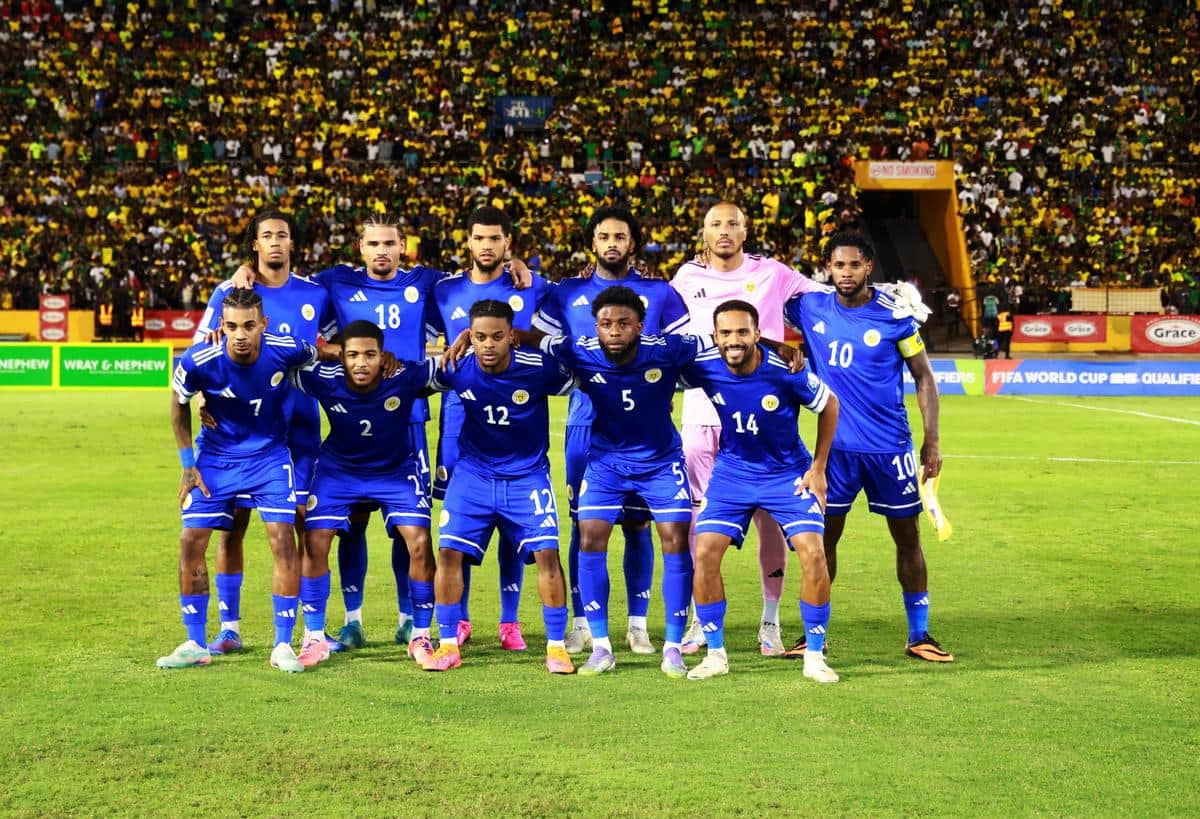
On November 18, 2025, the global football landscape was shaken as Curaçao officially secured qualification for the 2026 FIFA World Cup in the United States, Canada, and Mexico. A tense 0–0 draw against Jamaica at Independence Park in Kingston proved enough to seal a place on the sport’s biggest stage.
With a population of just 156,000, Curaçao has become the smallest nation by population ever to qualify for a World Cup, eclipsing the record previously held by Iceland, who qualified in 2018 with around 350,000 inhabitants.
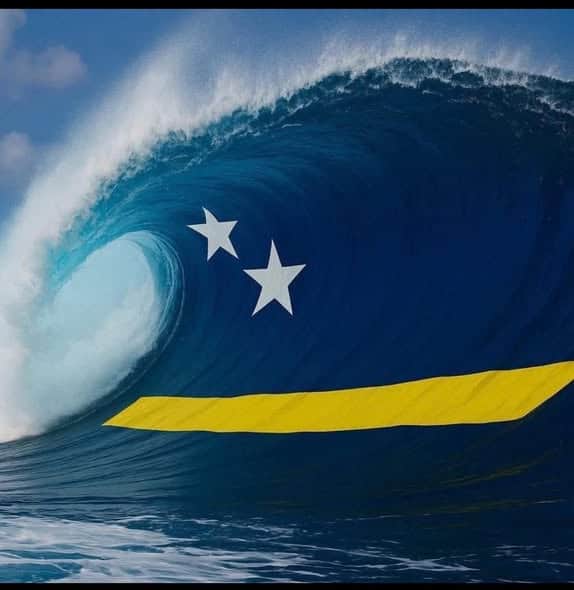
A Blue ShockWave From a Tiny Island
The Curaçao national football team is widely referred to with the nickname “The Blue Wave.” That nickname comes from a popular song/anthem called “Bluewave” that became associated with the team and has been embraced by supporters as a symbol of pride and unity around the squad’s historic success.
To grasp the magnitude of this achievement, one only needs to look at the number of far larger footballing nations that fell along the way. Countries with deeper resources, broader talent pools, and more established infrastructures failed where Curaçao succeeded. Smaller than many cities across the Americas, the island executed a near-flawless qualification campaign, built on discipline, tactical clarity, and remarkable consistency.
This success was no coincidence. It was the result of a long-term project that matured steadily, driven by a generation of players accustomed to high-pressure environments in European football. Their composure in decisive moments proved invaluable.
The Mastermind: Dick Advocaat
Central to this historic breakthrough was the appointment of Dick Advocaat in early 2024. At 78 years old, the veteran tactician is on course to become the oldest head coach in World Cup history, surpassing the previous record held by Otto Rehhagel (71), unless 80-year-old Mircea Lucescu qualifies with Romania through the European playoffs.
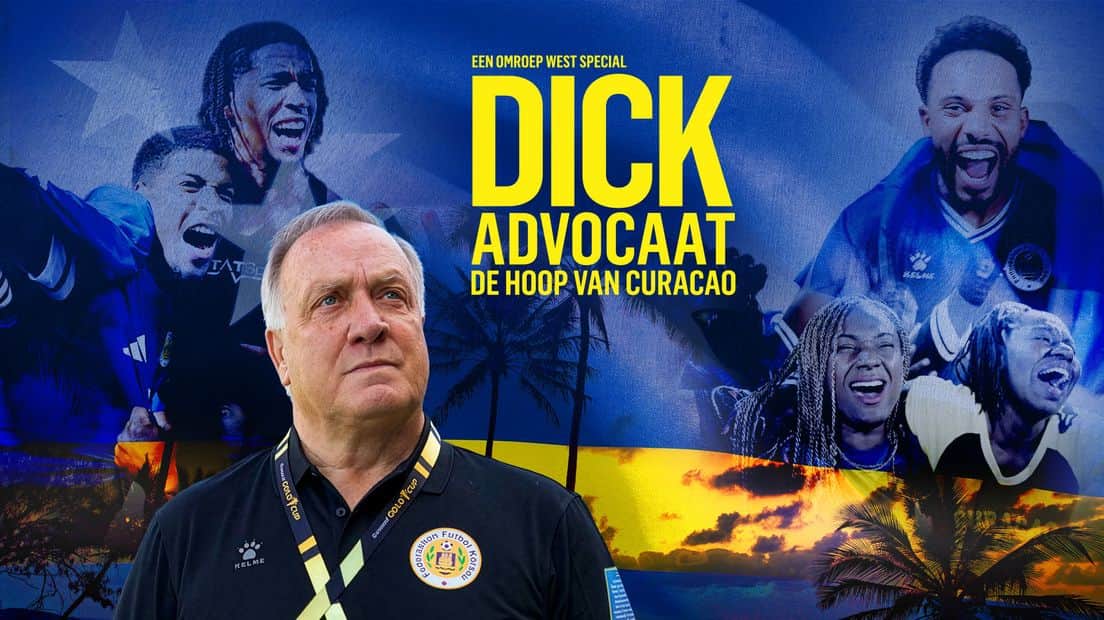
For Advocaat, this accomplishment adds another remarkable chapter to an already extraordinary résumé. He has previously managed national teams such as the Netherlands, South Korea, Belgium, and Russia, and has captured league titles in multiple countries. His experience, pragmatism, and authority provided Curaçao with exactly the leadership required at the highest level.
The Power of the Diaspora
A defining factor in Curaçao’s rise has been the strategic integration of its diaspora. By effectively leveraging FIFA eligibility regulations, the football federation recruited high-level players developed within the Dutch academy system.
The qualifying squad relied heavily on players born and raised in the Netherlands, competing across leagues in the Netherlands, England, Turkey, and Saudi Arabia. Remarkably, none were selected directly from Curaçao’s domestic league. This international blend delivered a team rich in experience, physicality, and tactical intelligence—perfectly suited to the demands of World Cup qualification.
More Than a Football Fairytale
Curaçao’s qualification is more than a sporting miracle. It is a story of vision, identity, and intelligent decision-making. A small island nation that proved that size, resources, and population are not definitive limits in modern football.
In 2026, Curaçao will stand among the giants of the game. And by then, no one will be calling it a fluke. ⚽
Curaçao: The Little Island That Became a Baseball Giant
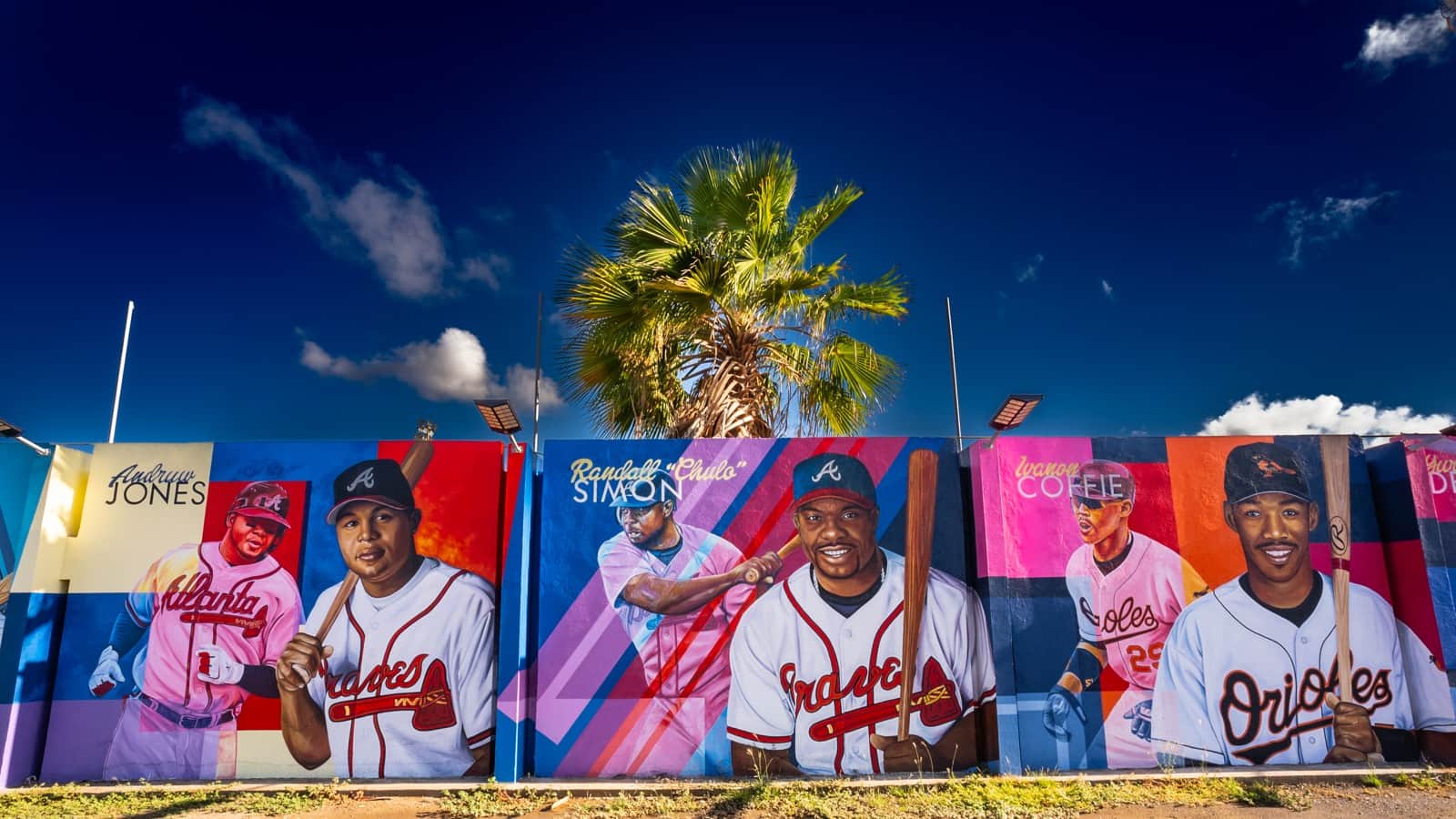
When you think of baseball powerhouses, you might picture the United States, Japan, or the Dominican Republic. But hidden in the Caribbean Sea lies a small island that consistently produces some of the most talented players in Major League Baseball — Curaçao.
With a population of just about 160,000 people, Curaçao’s contribution to professional baseball is nothing short of remarkable. The island has produced around 17 Major League players throughout history (including but not limited to Andruw Jones, Kenley Jansen, Ozzie Albies, Andrelton Simmons, and Hensley “Bam Bam” Meulens) — a per capita rate that rivals or even surpasses that of much larger nations.
How does such a small island consistently produce world-class baseball players? The answer lies in a powerful combination of culture, environment, and community spirit — a blend that makes Curaçao one of the most remarkable baseball hotbeds in the world. But do you know what might be the most important factor?
Curaçao’s baseball diamonds are far from pristine. Locals call them “rock fields” — hard, dusty, uneven surfaces made of volcanic ash and dirt. Yet these rugged conditions shape players with incredible adaptability and lightning-fast reflexes, turning local kids into some of the sharpest fielders in the world. Watch one of the rising stars from Curaçao, Ceddane Rafaela, playing for the Boston Red Sox! On 2 November 2025 this 25 years old center fielder was named American League Gold Glove Award winner for outfield magic in 2025.
Did you know that at the 2011 Baseball World Cup, held in Panama, the Netherlands defeated the heavy favorite and multiple champion Cuba 2-1 in the final, thereby becoming the 2011 Baseball World Champion? Watch it here! This was the first and, so far, the only time a European country has won the Baseball World title.
The victory was largely due to the enormous contribution of players hailing from Curaçao (and other Caribbean parts of the Kingdom, such as Aruba). More than half of the squad had Caribbean roots.
Two Stars: Curaçao and Klein Curaçao
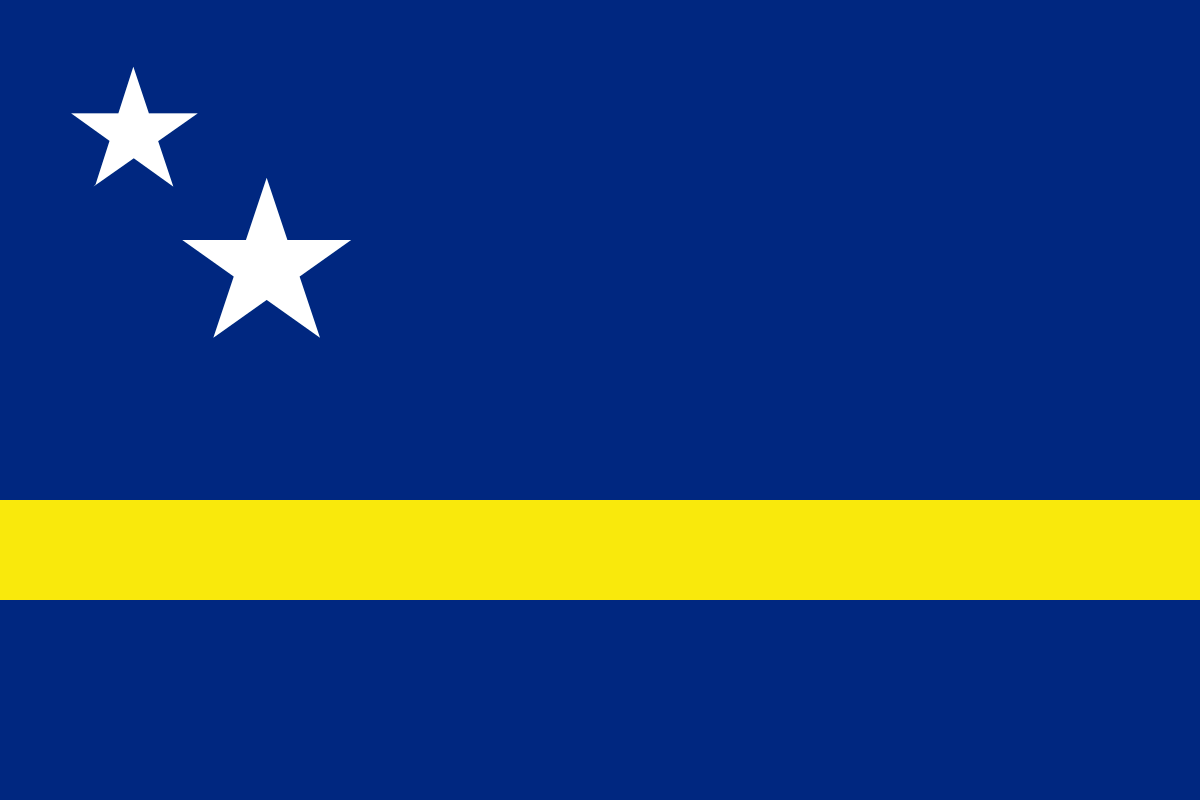
The national flag of Curaçao was officially adopted on July 2, 1984. It initially represented the island territory within the Netherlands Antilles, but since 2010 the flag has symbolized the autonomous country of Curaçao.
The design features a blue background with a narrow yellow stripe just below the center. The blue represents the sea and the sky, while the yellow line stands for the tropical sun. In the upper left corner, there are two white stars: the larger one represents Curaçao, and the smaller one represents Klein Curaçao.
Each star has five points, symbolizing the five continents from which the people of Curaçao trace their roots. In this way, the flag reflects the island’s cultural diversity and open character.
Every year on July 2, Flag Day (Dia di Bandera) is celebrated in Curaçao. This day marks the official adoption of the national flag in 1984 and has become an important celebration of the island’s identity, culture, and pride.
World's Longest Operating Floating Pontoon Bridge
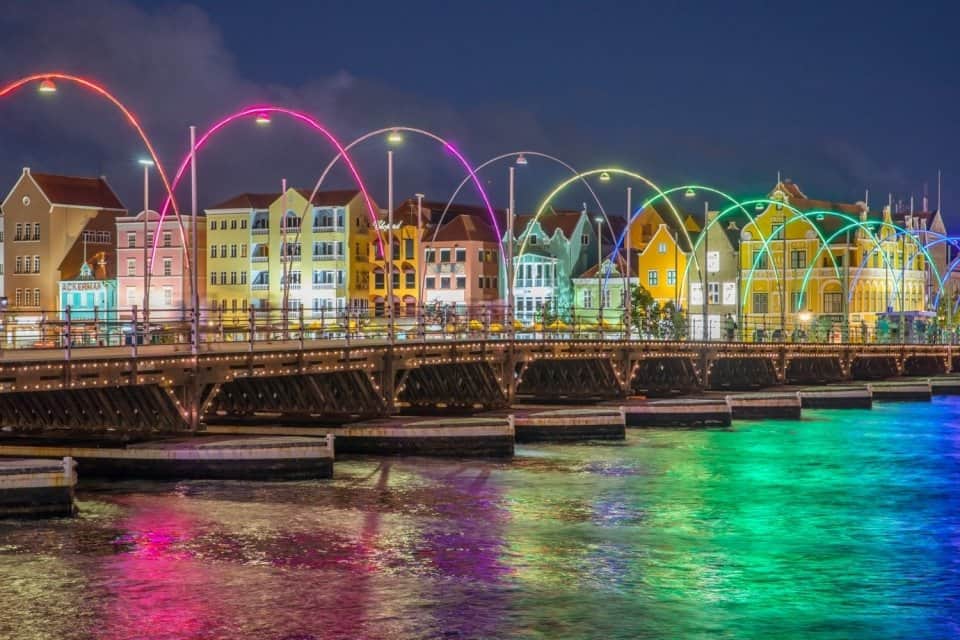
The Queen Emma Bridge or Pontjesbrug, known locally as the "Swinging Old Lady," is the world's longest operating floating pontoon bridge (approx. 170 meters), which swings open regularly to allow ships to pass into St. Anna Bay.
Opened in 1888, it is over 135 years old. Its famous nickname comes from its unique pontoon design: instead of lifting like most bridges, it swings open horizontally on large hinges to let ships pass into St. Anna Bay. As it moves, the entire bridge gently sways over the water, creating the graceful “swinging” motion that inspired its name.
Tallest Bridge in Carribean
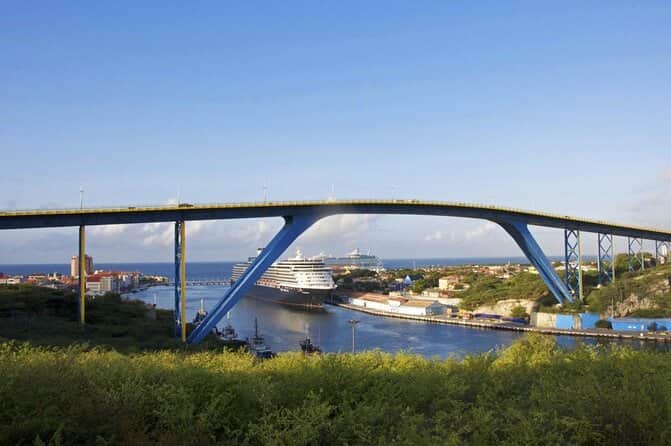
The Queen Juliana Bridge in Curaçao stands at an impressive 56.4 meters (185 feet), making it the tallest bridge in the entire Caribbean. Its extreme height is critical, as it ensures large tankers and other major vessels can pass beneath it to reach Willemstad's inner harbor.
Why Curaçao's Houses are Pastel-Coloured
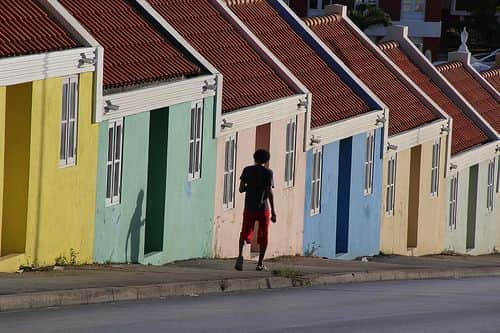
The iconic pastel palette of Curaçao originated in 1817, not by design, but out of pure necessity, when Governor Albert Kikkert introduced a law banning the blinding white colour due to his own severe migraines. This medical advice led to the 'Law of Colour,' requiring houses to be painted in softer shades. Read more in our Blog on this website.